In the footsteps of the first tourists to Lisbon... after the earthquake of 1755 !
The incredible experience of Count Gorani (1765)
The Milanese Count Giuseppe Gorani is an adventurer. He came from a destitute nobleman and from childhood had a penchant for “depraved tastes, deplorable habits”. After a military career with the Austrians, he ended his life as a French diplomat during the Revolution. Travelling through the lands of Europe, ruined by the Seven Years’ War, he tried his fortune in Portugal to serve the Marquis of Pombal. In his letters, he recounts his misadventures as a night owl in a ravaged Lisbon. This writing is exclusive and shows how dangerous Lisbon was at that time.
When this Italian Candide embarked at Montijo at 6.30 a.m. on 1 November 1765, he still had in mind the superlatives that were circulating about Lisbon. That mythical city of Luis de Camoes’ heroes ! Since he set out on this long journey, Giuseppe has been busy learning Portuguese and reading a fine edition of the Lusiadas on several occasions : his wish is to make a strong impression on the Portuguese.
When I was in the middle of the Tagus, I saw the superb capital of Portugal, which presented itself to me along the river in an amphitheatre between the rising and the setting sun.
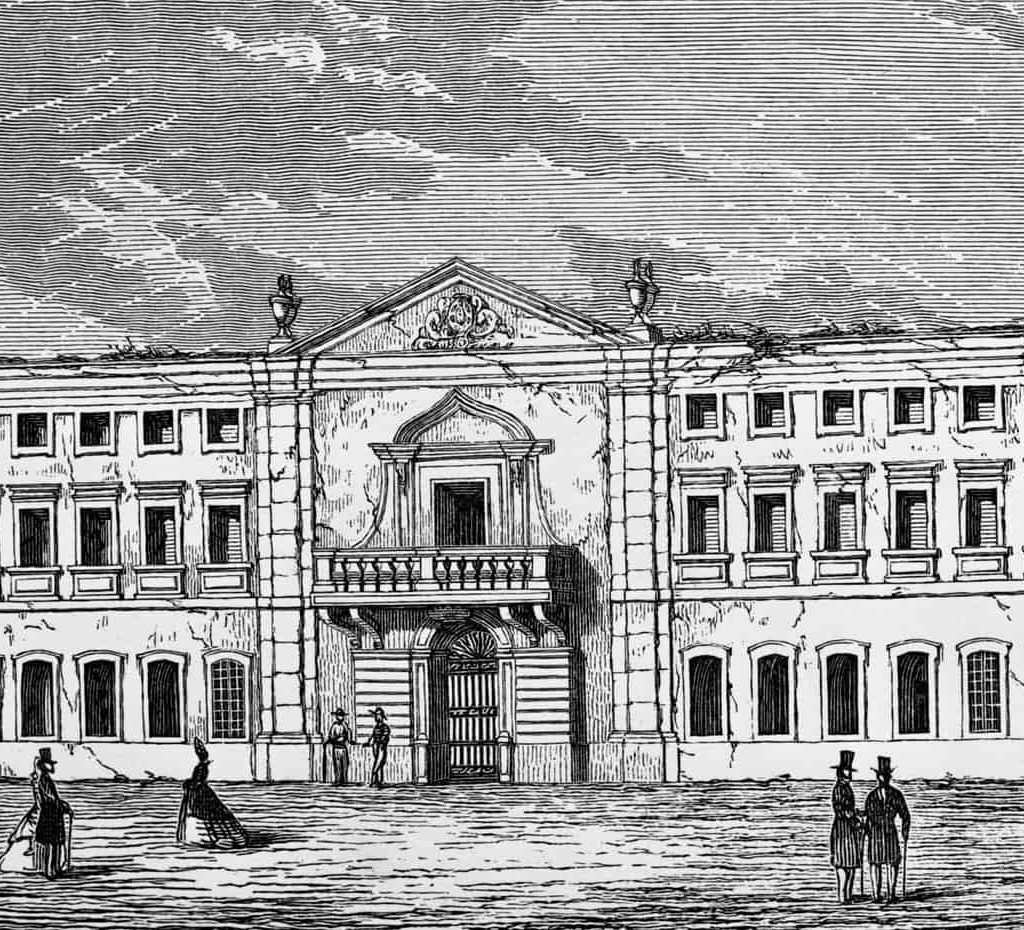
On landing in Terreiro do Paço, he observed a city under reconstruction. “The earthquake must have been extremely bad because ten years later, on my arrival in Lisbon, this city still showed so much rubble“. From the brand new Augusta Street, he heads straight to his inn, helped by a young Galician carrying his luggage. “For the Galicians do in Lisbon what the Savoyards do in Paris”. A stone’s throw from the Palace of the Inquisition, the boy puts him up in a pension with a strange name : As almas santas do purgatorio. Does this portend a disastrous fate ? His first impression is indeed slightly distorted : the new Baixa has begun to show its best features. Hell has not yet been revealed to him…
Post-Terramoto Inquisition Palace (Estaus Palace) rebuilt by Carlos Mardel
Let's set the scene for this commedia dell'arte !
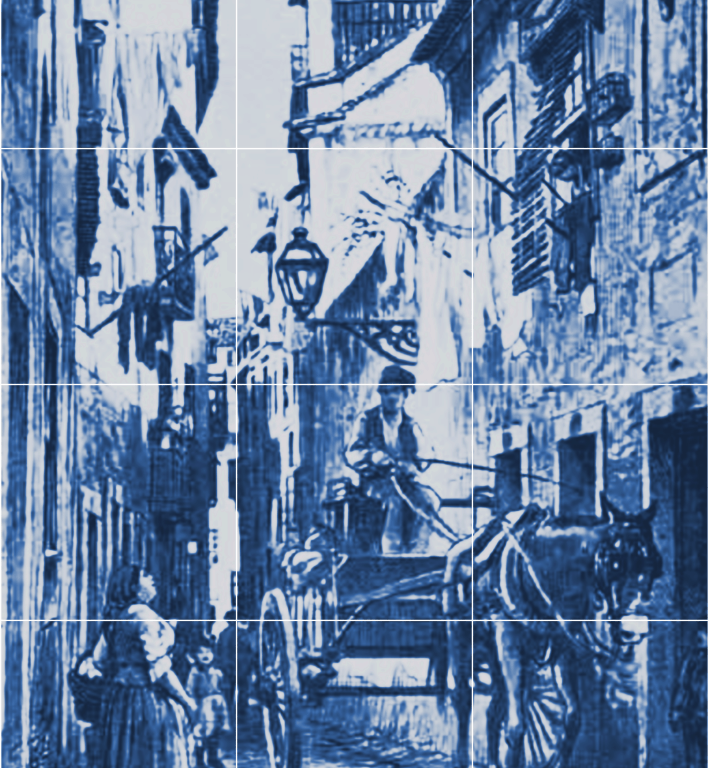
In the years following the terramoto, Lisbon is a frightening chaos of toppled palaces and burnt-out churches. In the idle districts, the narrow streets are paved with small sharp stones that bleed your feet. At sunset, the people throw their rubbish on the street. It is impossible to walk around Lisbon in winter without getting knee-deep in filth. The transport litters are covered with leather to avoid splashing on the ladies’ dresses !
During the fine weather, this filthy mud accumulates and dries out in the sun. It becomes a fine, blackish dust which, when it comes into contact with the wind, the passage of people and carts, flies away and enters the houses, covering the furniture endlessly. Either you are stained with filth, or you are covered by dust.
Although some servants would throw the sludge into the river, the majority of Lisbon’s inhabitants made do with it. Indeed, at night the minnow does its business in the alleys and during the day behind an archway.
Once darkness falls, this filth is a treat for Lisbon’s 80,000 stray dogs. Packs of 40 to 50 dogs gather in front of cabarets, taverns and frigideiros, the travelling caravans where sardines are fried.
If the unbearable smells invade the streets and the houses, it is still pleasant compared to the high-pitched and piercing noise of the cart wheels. A torment for the ears! The carters refuse to grease the axles because they seem to be convinced that the noise scares the devil away…
Street of Mouraria : Sao Pedro Martir
At dusk, Lisbon becomes a nest of thieves and murderers. The scoundrels of the highways flock to the capital. On the prowl, brigands hide in the ruins and rob the noctambulists. At the end of the century, attempts were made to install public lighting, but this project was soon abandoned because the lamps were constantly destroyed by the criminals.
People were murdered with long, sharp knives. The motive for the crime ? A story of jealousy, revenge… A certain form of fatalism, even of compassion, is established among the Portuguese. “Coitadinho !” they say. A visiting Frenchman testified in 1766 : “I saw in Lisbon a servant murder his comrade in the middle of the street at high noon, withdraw coldly with his knife in his hand, be taken to prison laughing and come out a few months later to work as an executioner”.
And Count Giuseppe experienced his first Lisbon evening...
On 1 November 1765, the summer of Saint Martin’s Day is in full swing. The Rossio square is dead silent, it is a day of great penitence, as it is the 10th anniversary of the earthquake. “When the sun went down and we were in the hour that is called between dog and wolf, I also came out of my den”. Giuseppe explores the Baixa from top to bottom to start getting his bearings. Just as he was thinking of going back to the hostel, an African woman came to him. With a rosary in her hands, she recites Pater and Ave Maria. Then she offers him a bonita rapariga with incredible charms. During his stay in Evora, he had been deeply seduced by Portuguese women, so he was easily convinced by this “priestess of love”. Giuseppe took the bait, aware of his negligence. At that time, it was not uncommon to hear of the brutal deaths of Italian travellers when they passed through Lisbon; this was undoubtedly a reckless nation for night trips !
A priestess of love ?
Oh what a libertine ! To go on adventures like that, in a huge city, full of ruins, through streets I did not know ! What name to give to such pitiful conduct ?
Lost in the bairros of Lisbon, our count is led by the duenna. He walks through 5 or 6 streets before climbing to the 3rd floor of a house. The girl is a beauty ! After supper, she soon asks him to take off his clothes. Six hours later, Giuseppe feels sleepy when he hears thumping noises behind the door. Panicking, he jumps up.
It’s rats ! replies the rapariga. No way ! Naked as a Spartan, Giuseppe takes his pistol in his right hand, his sword in the left. Barely has the door opened, he shoots at the lantern bearer who collapses. Jostling the other assassins, he dashes down the stairs to risk his life in the dark streets of Lisbon.
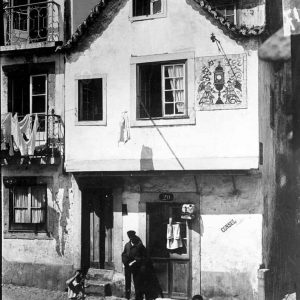
It was probably in one of these old buildings that the Count's misadventure took place. As we have no clue as to the exact location, our imagination is running wild!
One can imagine [...] in what state I was, without stockings, without breeches, without shoes, without a shirt, without a hat, with a naked sword in my hand, jumping from one street to another, often in the middle of rubble and ruins.
Exhausted, completely bloodied, the Count hides in a hovel, revealed by the moonlight. Seeing the rascals pass him by, he leaves his hiding place and wanders from street to street in search of shelter.
Luckily, he meets a man with a lantern, who, after convincing him of his misadventure, helps him to find his way back. Once in his room, the Portuguese man takes care of him, considering him as a brother. This timely encounter convinces the Count that if men are willing to deal with a stranger with such kindness, the Portuguese are indeed a great nation !
Shopping Basket
Talk with us :)
1
Bom dia ! How can I help you? Please click on the button at the bottom right to start the chat.